
How Much Does It Cost to Build a House in Gauteng in 2026
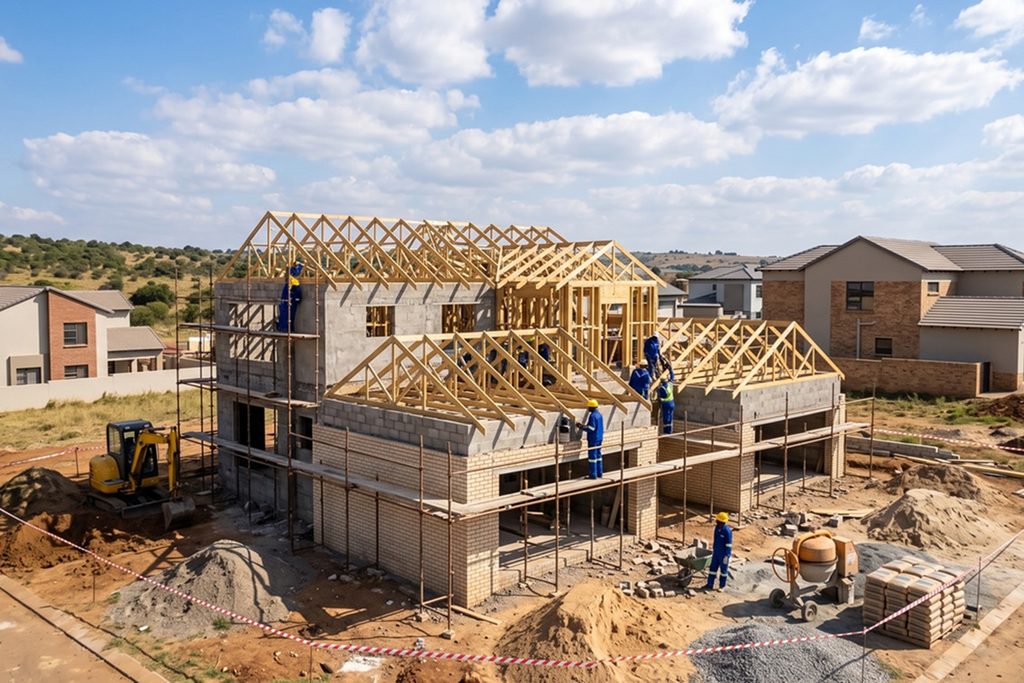
In 2026, building a house in Gauteng typically costs between R10,000 and R22,000 per square metre for standard to mid-range suburban homes, while high-end architectural builds in prime estates range from R25,000 to R35,000+ per square metre. For an average 200-square-metre, three-bedroom family home in Johannesburg or Pretoria, expect an overall construction budget between R2.4 million and R4.4 million, excluding land purchase and municipal connection fees.
Average Building Costs per Square Metre in Gauteng
Construction pricing across Gauteng varies based on architectural complexity, site conditions, and the quality of interior and exterior finishes selected.
Gauteng residential building rates per square metre fall into three broad specification tiers:
- Standard finishes: R9,500 to R12,500 per square metre for basic ceramic floor tiles, standard brickwork, prefabricated roof trusses, standard sanitary ware, and painted hollow-core internal doors.
- Mid-range finishes: R13,000 to R19,500 per square metre for porcelain tiling, aluminium window frames, engineered quartz countertops, solid wood doors, and energy-efficient low-E glazing.
- Luxury custom finishes: R20,000 to R35,000+ per square metre for double-volume structural steel framing, imported porcelain slabs, custom cabinetry, smart home automation, and integrated backup energy solutions.
Key Factors Influencing Gauteng Construction Budgets
Beyond square metre estimates, specific regional and property-level factors directly affect overall project expenditure.
Foundation and Soil Conditions
Gauteng features varied geotechnical conditions that dictate foundation engineering. Areas with dolomite soil in Centurion or expansive clay in parts of the East Rand require engineered raft foundations or deep piling, which can increase substructure costs by 15% to 30% compared to standard strip footings.
Off-Grid Power and Water Infrastructure
Load-shedding mitigation and municipal water disruptions mean modern Gauteng builds routinely include backup utility installations. Budgeting for hybrid inverter and lithium battery setups, solar arrays, and municipal backup water tanks with pressure pumps is standard practice for new developments.
When calculating your total project outlay, factor in these essential preliminary and infrastructure expenses:
- Professional fees: 10% to 15% of the total build value covering architects, structural engineers, and quantity surveyors.
- Regulatory compliance: Municipal plan submission fees, NHBRC enrolment fees, and land surveyor certifications.
- Site infrastructure: Boundary walls, automated gates, electric fencing, and municipal water and electricity meter connections.
- Off-grid additions: Solar photovoltaic systems, battery storage, rainwater harvesting setups, and borehole drilling.
Breaking Down the Build: Where Your Money Goes
Understanding cost allocation across project phases keeps your budget on track. Working with established construction services in Gauteng ensures that each build phase meets municipal building codes and NHBRC standards without costly site rework.
A typical residential building budget in Gauteng distributes across these core structural phases:
- Substructure and earthworks: 15% to 20% of total costs for site clearing, trenching, reinforcement steel, damp-proof membranes, and concrete slab pouring.
- Superstructure and masonry: 25% to 30% for external cavity walls, internal partition brickwork, structural concrete lintels, and columns.
- Roofing and insulation: 10% to 15% for timber or light-gauge steel trusses, concrete roof tiles or Chromadek sheeting, and SANS-compliant thermal roof insulation.
- Internal and external finishes: 25% to 30% covering plastering, screeding, painting, tiling, built-in cupboards, and sanitary ware installation.
- Electrical and plumbing services: 15% to 20% for first and second-fix electrical wiring, plumbing runs, geysers, lighting fixtures, and DB boards.
Practical Ways to Control Construction Costs
Smart planning before breaking ground prevents cost overruns during construction. Structural simplifications deliver the biggest savings without compromising aesthetic appeal or build quality.
To maintain budget control during your build, consider these practical strategies:
- Optimise the building footprint: Square and rectangular floor plans minimise external wall surface area, reduce foundation perimeter length, and simplify roof structures.
- Lock in specifications early: Avoid variation orders once construction begins, as contractor alterations mid-build introduce administrative markups and delay schedules.
- Standardise structural spans: Keeping room dimensions within standard timber and concrete beam spans avoids expensive heavy structural steel work.
- Choose registered contractors: Hiring NHBRC-registered building contractors protects you against structural defects and ensures compliance with South African National Standard SANS 10400.
Let ANL Projects Build Your House
Building a new home in Gauteng demands clear cost visibility, strict timeline management, and skilled on-site execution. ANL Projects provides professional construction and project management solutions across Johannesburg, Pretoria, and surrounding areas. Our team handles every phase from initial groundworks to final handover, ensuring your project is completed within budget and built to lasting standards. Click the button below to get a quote for your next project.
FAQs
How long does it take to build a house in Gauteng?
A standard 200 to 300 square metre single-storey house typically takes 6 to 9 months from site handover to completion. Larger double-storey residences or homes on steep sites with complex foundations can take 10 to 14 months.
Is it cheaper to build or buy an existing house in Gauteng?
Buying an existing home often carries a lower upfront cost per square metre and avoids construction delays. However, building allows you to design modern energy-efficient layouts, eliminates transfer duty on the building value, and reduces repair costs associated with older properties.
What is the minimum cost per square metre to build in Gauteng in 2026?
Basic turnkey construction with entry-level finishes starts at approximately R9,500 to R10,500 per square metre in Gauteng, assuming level ground and standard strip foundations.
Do I need NHBRC registration to build a house in Gauteng?
Yes. South African legislation mandates that all new residential homes must be registered with the National Home Builders Registration Council (NHBRC) before construction begins. Major banks will not disburse building loan drawdowns without proof of NHBRC enrolment.